Industry Insight
Modern LED light leaves out infrared that may help human vision

A small study found that adding broad-spectrum incandescent light to an LED-lit office improved workers' color vision.
Years ago, most offices traded their overhead bulbs for LEDs. Homes followed. An LED is efficient because it makes only the light eyes can see and almost nothing past it.
In a London workspace lit by nothing else, two weeks of old incandescent desk lamps improved workers’ color vision by about 25%, a new study reports. The wavelengths LEDs leave out may play a role in keeping vision working well.
Edward Barrett of the Institute for Environmental Design and Engineering and Glen Jeffery of the UCL Institute of Ophthalmology ran the test on 22 people who work in the building. Half of them were a comparison group, and the whole thing ran through one dark, London autumn.
Sunlight carries more than visible light
Sunlight reaching the ground runs from about 300 to 2,500 nanometers. Eyes register roughly 400 to 700 of that. Everything longer is infrared, and it arrives whether anyone can see it or not.
It also goes deep. A 2025 paper from Jeffery’s lab measured sunlight’s long wavelengths passing right through the human body.
Firelight carries it. So did the Edison filament bulb, the standard indoor light until around 2000. LEDs took over after that, and their output stops near 650 nanometers with a sharp peak in the blue, around 450.
In animals, the two ends of that spectrum do opposite things. Light at 420 to 450 nanometers lowers the output of mitochondria, the parts of a cell that make its fuel, while longer red and near-infrared light raises it.
Fruit flies kept under unfiltered white LED light lost half their median lifespan against flies kept in the dark.
Put a yellow filter over the same lamps, which strips out the short wavelengths, and the loss of lifespan was only 4%. Same bulbs, same flies, and the difference was which end of the spectrum got through.
Infrared was blocked at the windows
Barrett and Jeffery worked at UCL at Here East, a converted press and broadcast center built for the London 2012 Olympics. The room is 30 feet wide and 59 feet deep (9 by 18 m), and the benches sit more than 160 feet (50 m) from the front doors.
To find out what light was reaching the benches, Barrett photographed the building with a camera modified to record infrared.
From outside, the windows read as mirrors, because the glazing carries a film that bounces the long wavelengths away. Inside, infrared showed up only in the doorway, and only when the doors were open.
Photographs of the work area itself came out black. All of the subjects had worked in that light for more than two years.
The test ran from October into December. London daylight drops from ten hours to seven and a half over those months, and by December the sun is down at about 4 p.m.
Most of the group didn’t leave the building during the working day. The buses and trains home used LED light, and so did their houses.
Color vision improved about 25%
Everyone took a test called ChromaTest before anything changed. Letters appear against a speckled background in either the red or the blue range. The contrast drops each time a letter is read correctly and rises each time it isn’t.
Settling on a threshold takes 70 to 100 tries in a dark room, so a windowless room nearby was set aside for it. That gives a number for how faint a colored letter can get before a person loses it.
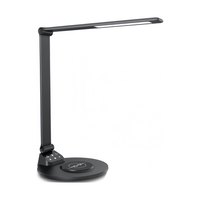
Then 11 of them got desk lamps with 60-watt clear Edison bulbs on their benches. The other 11 stayed under LED light alone.
Next to those ceiling lights the lamps looked dim, but their light runs past 1,700 nanometers, further than the spectrometers could follow. That extra reach is the whole intervention.
Two weeks later, all 11 with desk lamps read fainter letters than they had at the start, in the red range and the blue range alike, by about 25%. The comparison group tested where it had before.
The gains outlasted the lamps
The lamps came out after two weeks and the 11 went back to LED light alone. Tested again at four weeks and again at six, they held both readings.
Earlier work couldn’t do that. In a 2021 experiment, the same lab gave people aged 37 to 70 a single, three-minute dose of 670-nanometer red light. Color contrast improved, the blue range more than the red, and the gain faded in about five days.
Two weeks of a broad spectrum moved both ranges by the same amount and held them there for at least a month after the light was gone. Where the effect ends is still unmeasured, because six weeks was the last reading anyone took.
Mitochondria may explain the change
Every cell carries small compartments that burn sugar and oxygen to make the chemical the rest of the cell runs on.
The retina holds more of them, and burns more fuel, than any other tissue in the body. That is why aging vision tracks so closely with how well those compartments work.
Retinal fuel production falls with age, and long wavelength light partly corrects it across species.
Why longer wavelengths help mitochondria is still argued.
Still searching for the mechanism
One old account had a single protein in the fuel-making chain absorbing the light directly, but the effect turns up in dishes of cells that lack it.
A second has long wavelengths thinning the water around the tiny rotary pumps that build the fuel molecule, letting them spin faster.
The viscosity idea doesn’t fit a six-week effect, since water thickens again the moment the light stops. So the authors point to a third step.
Red light raises production of the chain’s own proteins, complex IV among them, and more machinery lasts as long as machinery lasts.
The study was small and short
Twenty-two people isn’t many, and the authors say so. Everyone arrived healthy and between 23 and 65 years old, with normal corrected vision.
Each person was measured against their own baseline, which covers some of the ground a bigger group would. No mitochondria were measured here.
The color test is the measurement, and the mechanism is inference from other experiments in flies and mice.
LEDs are more efficient
Incandescent bulbs are being phased out worldwide on efficiency grounds, so a room full of them isn’t a policy anyone will write.
Barrett and Jeffery tried lamps built from several near-infrared LEDs at different wavelengths. Narrow peaks give a spiky output rather than the smooth curve of a filament, and it hasn’t delivered yet.
They favor a cooler filament. It draws less power, lasts longer, and shifts the output toward the long end. In a halogen bulb the evaporated tungsten settles back onto the wire rather than darkening the glass.
How much infrared a room actually needs is a figure nobody has. Until someone measures it, the case for relighting workplaces and hospitals rests on 22 people, one dark winter, and some desk lamps.
The full study was published in the journal Scientific Reports.